A seat can fit a drawn turning space in two positions while failing between them. To make that problem concrete, take the textile KLIPPAN loveseat dimensions in IKEA's October 2025 US buying guide: 70⅞ inches wide by 34⅝ inches deep. Place that assembled footprint in an invented 76-inch-square turning bay. The original calculation below follows one very specific motion, a horizontal turn about the rectangle's fixed center. It is a planning counterexample, not instructions for moving a sofa or proof that every possible delivery method fails.
Fix the object and the proposed motion
The guide distinguishes the textile sofa's unassembled frame from the coated-fabric version that arrives assembled. Our rectangle uses the textile model's assembled width and depth. Those measurements do not describe its package, the coated-fabric model's different width or a partially dismantled object. We are asking what this one assembled plan would do inside the declared bay.
Imagine the bay between two other parts of a hypothetical room route. Its boundary is a square, 76 inches on each side. The sofa rectangle starts centered with its long side horizontal, then turns through a quarter rotation while its center stays fixed. We ignore height and thickness beyond the stated plan. Those assumptions deliberately isolate the turning conflict; they do not model a real doorway, people handling furniture or a complete three-dimensional route.
The beginning and end both fit on paper
At the start, 70.875 inches sits across the 76-inch bay and 34.625 inches sits along it. Centering leaves 2.5625 inches on each side of the long dimension. At the quarter-turn endpoint, the dimensions exchange directions. That final rectangle also lies inside the square. Looking only at those two drawings could therefore make this proposed motion appear possible.
But the outer width changes continuously during the turn. At an angle θ from the starting position, its horizontal projection is 70.875 cos θ + 34.625 sin θ. The vertical projection is 70.875 sin θ + 34.625 cos θ. Both must remain within the bay for this particular centered rotation to stay inside its boundary. Fitting the endpoints answers only two moments of the question.
The widest intermediate position exceeds the bay
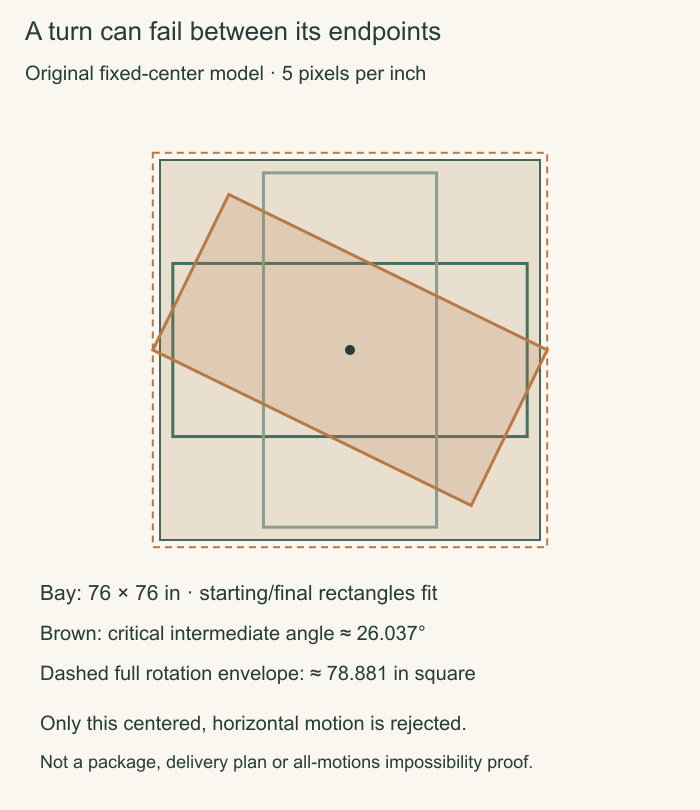
The largest horizontal projection is the square root of 70.875² + 34.625², approximately 78.881 inches. It occurs at approximately 26.037 degrees in this model; the vertical projection reaches the same maximum later in the turn. The full centered quarter-turn therefore needs an enclosing square at least 78.881 inches across just to contain the ideal rectangle.
Our proposed bay is 76 inches, so its width is about 2.881 inches short of that geometric envelope. The intermediate rectangle crosses the boundary even though the first and last positions fit. The diagram shows the critical intermediate position and the larger envelope. This result rejects the specified fixed-center motion. It does not establish that translating the center, changing orientation in three dimensions or using a different delivery form is possible or impossible.
Use the failure to make the enquiry specific
Instead of telling a retailer that the sofa fits because both endpoint outlines fit, retain the assembled dimensions and the exact failed motion. A useful question is whether the actual product and delivery arrangement have an appropriate route through the real measured space. The people assessing that route need its openings, turns, height and actual delivery form, not just this invented square.
A larger bay in this two-dimensional model would still not certify a delivery. The value of the calculation is narrower: it catches one arrangement that a static outline misses. Before buying, keep the physical access assessment separate from this drawing and from the guide's statement that the textile frame arrives unassembled. A smaller package and an assembled seat are different objects to assess.
Sources & further reading
Published sources for the details and examples discussed in this story.