A guest can see several towels in a bathroom and still not know which one is theirs. The missing information may be a simple assignment rather than more storage. In this original short-visit plan, Robin and Ellis each receive a towel and a named place on existing suitable rails. The household cupboard continues to serve its ordinary rotation. The arrangement is a communication example, not a hygiene standard or a recommendation to install a particular fixture.
Give the two places names that survive a conversation
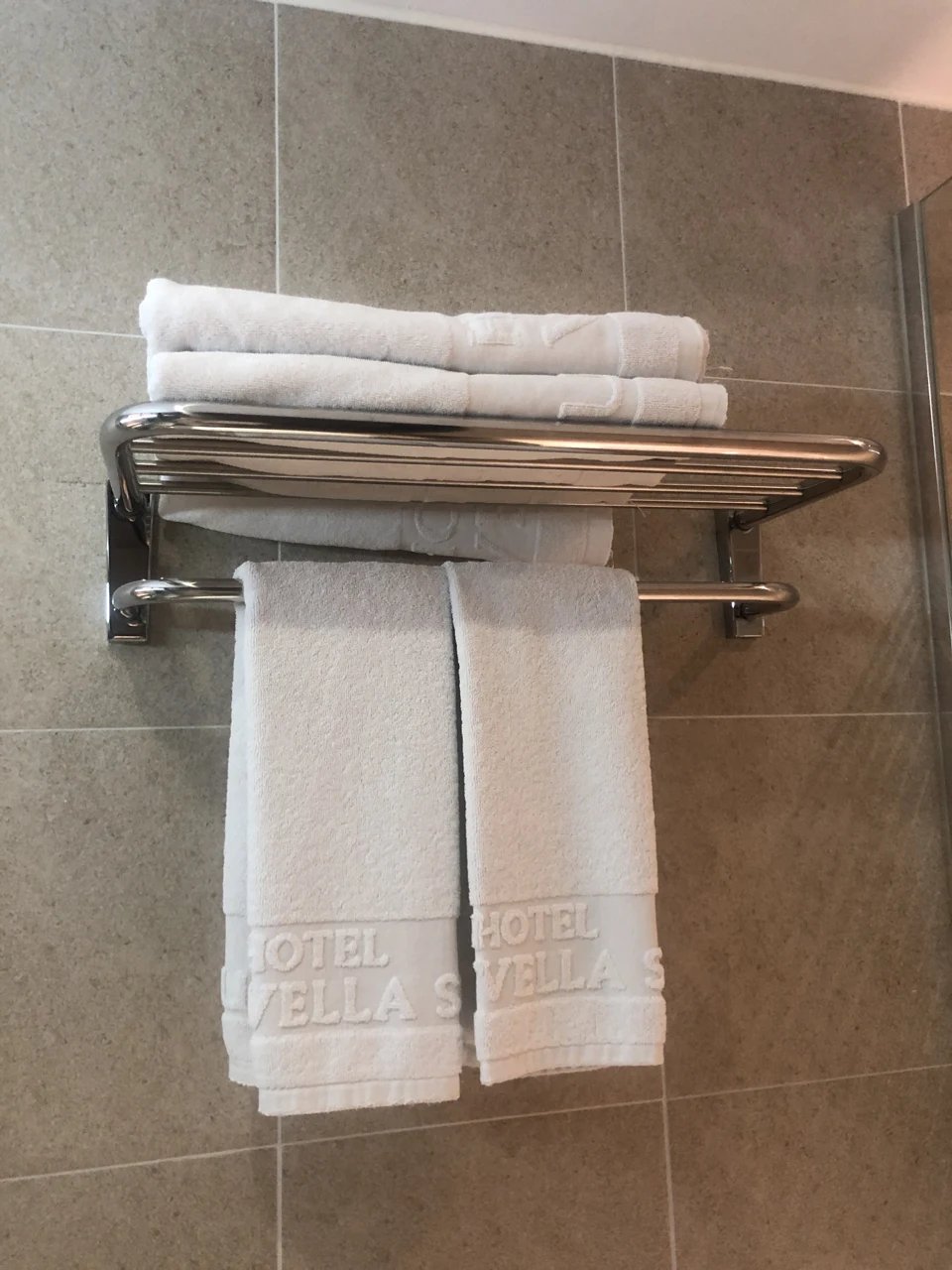
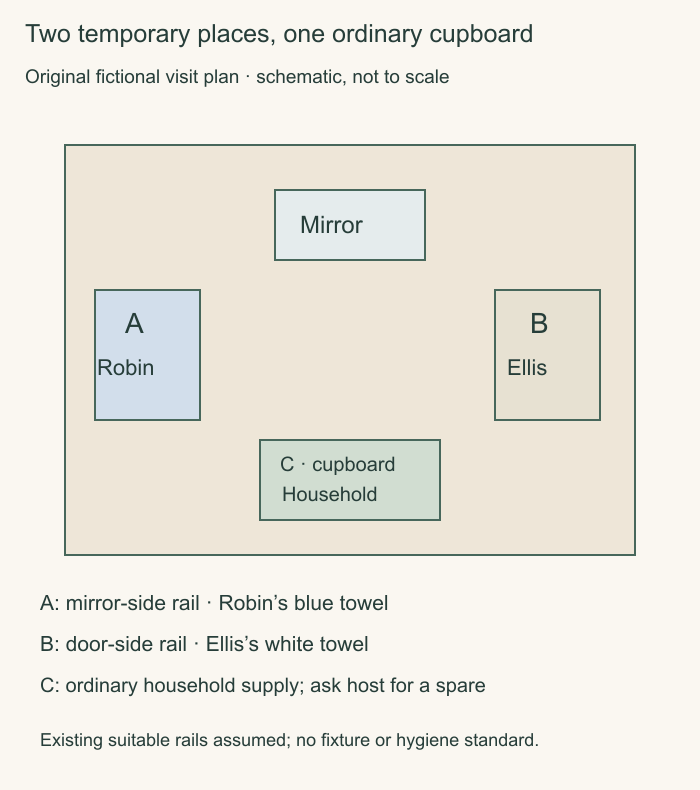
Imagine a bathroom with an existing rail to the left of the mirror and another beside the door. For this fictional visit, call them A, mirror-side rail, and B, door-side rail. Robin's blue towel belongs at A; Ellis's white towel belongs at B. The small plan labels the physical places as well as the towel colors, so a person need not remember the color alone.
The actual household would first establish that those rails and locations are appropriate for the towels and the room's use. Our drawing assumes that suitability; it does not specify fixings, loads, distances from water or electrical equipment. No new hook, ladder or freestanding unit is part of the proposal. If the real bathroom lacks two appropriate places, this exact arrangement has not been established simply by naming them.
Leave the household cupboard with its ordinary job
The cupboard marked C contains the household's usual clean rotation. It is not the guest towel return point. In the example, the host gives Robin and Ellis their clean towels on arrival rather than asking them to identify two suitable pieces from that cupboard. That removes a small decision from the guest without requiring every shelf to be relabeled.
A spare remains a request to the host in this particular arrangement. Another household could choose to make a specific spare accessible, but that would be another stated choice. The important point is that C does not quietly become an instruction to open every cupboard looking for a replacement. The plan makes the boundary understandable rather than relying on a guest to infer it from how neatly towels are folded.
Say the whole arrangement once
An original arrival message could read: 'Robin, the blue towel is yours; please use the rail left of the mirror, A. Ellis, the white towel is yours; your place is the rail beside the door, B. The cupboard is our usual household supply, so please ask me if you need another towel. Before you leave, keep your used towel on its assigned rail and I will take care of the laundry.'
That last sentence is the agreed ending for this invented visit. It should change if the actual host prefers a different appropriate laundry handoff. Do not add a universal washing schedule or a claim that this assignment prevents illness. The message answers ownership, location, spare supply and departure for two people; it does not answer every care question about their towels.
Reset the temporary assignments after the visit
Once the guests leave, the host follows the actual towels' care instructions and returns the room to its ordinary arrangement. A and B need not remain permanent guest stations. If a visitor found one description confusing, revise that location phrase before the next stay. Buying two more baskets would not correct a message that sent both people to the same rail.
The useful test is whether Robin can point to A and Ellis can point to B without searching the cupboard. This is a small, complete visit plan. It can coexist with a different everyday household routine because it declares where the temporary arrangement begins and ends.
Sources & further reading
Published sources for the details and examples discussed in this story.