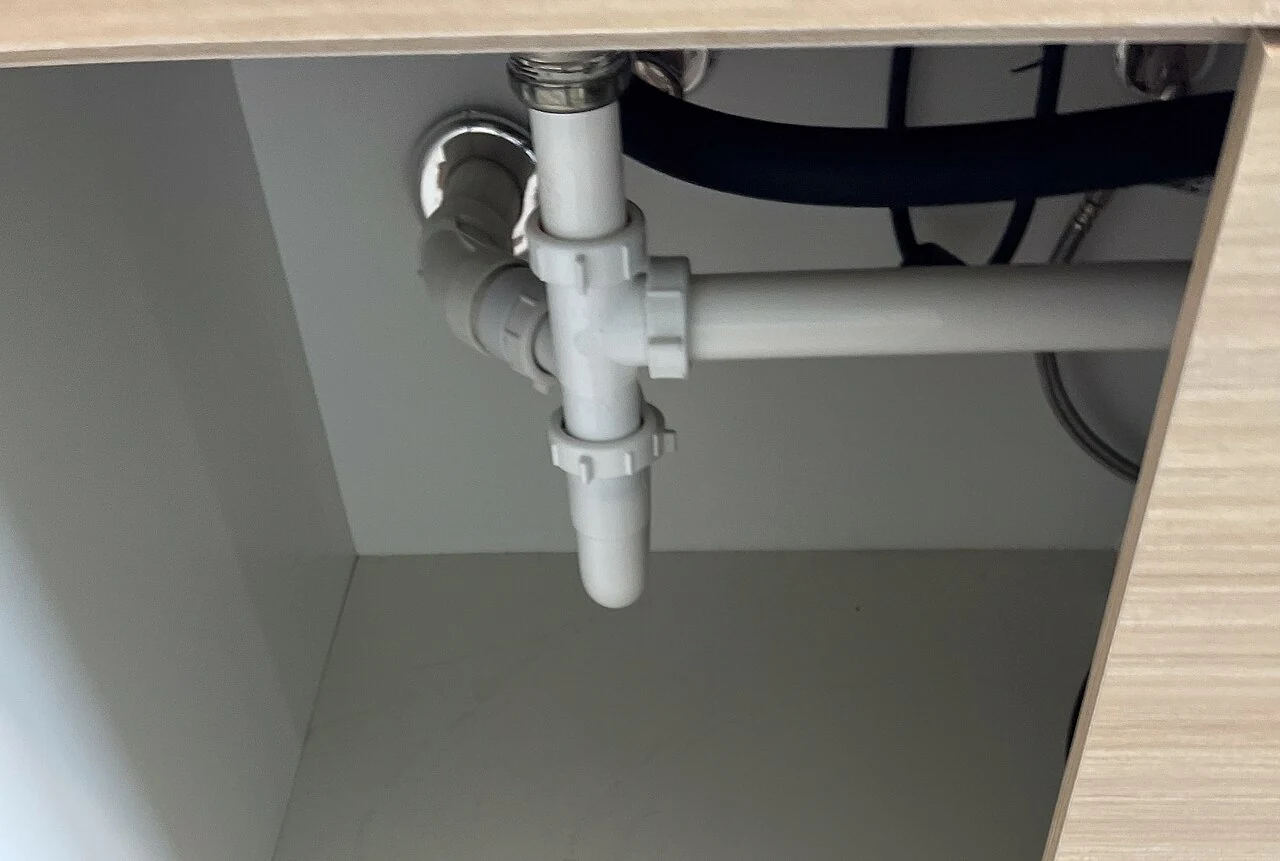
An under-sink cupboard is not an empty rectangular box. Pipes, valves, the basin above and the door hardware divide it into smaller usable spaces. An organizer needs to fit through those spaces while leaving the plumbing reachable. The useful decision is whether a particular unit can enter, operate and come out again without moving the services it must live around.
Mark the spaces that are not storage
With the cupboard accessible and ordinary loose items removed appropriately, look at the existing pipework, connections and any equipment occupying the cabinet. Record their positions without pulling, loosening or repositioning anything. Include the space beneath the basin rather than measuring only from the cabinet floor to its top edge. A tall basket may meet the furniture dimensions and still conflict with the basin or a connection above it.
Keep valves and areas needed for inspection or maintenance accessible. If you cannot identify what must remain reachable, ask the property contact or an appropriate professional before filling the space. An organizer is not a reason to move plumbing or conceal a condition that needs attention. Resolve an existing leak or damaged surface through the appropriate route before treating storage as the remaining problem.
Compare the opening with the occupied space
Record the clear entrance as well as the useful space inside. A face frame, center support or hinge can make the route through the front narrower than the cabinet's internal width. Note where a closed door occupies space and how it moves when opened. Check the organizer's complete dimensions, including handles, feet and any projecting rail or fitting, rather than its basket width alone.
Simplehuman's pull-out cabinet organizer documentation, for example, supplies model-specific dimensions and a load limit. Those details belong to the exact product, not every basket sold as an under-sink solution. Obtain the corresponding information for the unit you are considering. A nominal size in a product name is not a complete clearance specification.
Check the moving parts together
A pull-out needs room along its travel, not merely a place to rest when closed. Compare the manufacturer's operating arrangement with the open door and hinge positions. Consider the intended contents too: a handle or bottle projecting above the basket can meet a pipe even when the empty unit clears it. Do not force a demonstration around a connection to see whether it will bend out of the way.
An existing paper outline or a safe, non-loaded reference can help you understand a footprint, but it does not test installation strength or the behavior of a rail. Follow the maker's actual method where a physical check is appropriate. If you cannot establish an unobstructed path from the documentation and the cabinet, ask for guidance or choose a different format rather than planning an improvised modification.
Leave a way to remove the unit
Ask how the organizer and its contents would be taken out for inspection or maintenance. A shelf that technically fits behind a pipe may be impractical if removal requires disturbing the plumbing. Understand any release mechanism and whether a fixed installation preserves the access the property needs. Do not dismantle fittings or make new holes simply to answer an uncertain shopping question.
A removable container and an installed pull-out involve different commitments. Neither is universally better. Compare the access each leaves after the door closes, and identify who would perform any permitted installation. Check the cabinet material, required fixings and product instructions before assuming a rail can be secured wherever the floor appears clear.
Make the decision about clearance, not capacity
Keep four answers together: the available spaces, the open-door operating path, the maintenance/removal route and the exact installation/load requirements. A missing answer is a reason to pause. The largest stated capacity does not compensate for a blocked valve or a basket that cannot pass the hinge. Choose the arrangement that leaves the cupboard's essential functions usable, even if that means storing fewer objects there.
Sources & further reading
Published sources for the details and examples discussed in this story.