A narrow storage footprint can be easy to accommodate and still leave a maintenance question: how will you reach the floor it occupies? Consider IKEA's white VESKEN cart, article 004.712.22, beside an original fixed-base alternative with the same declared footprint. The comparison follows one task, exposing the occupied floor area. It does not treat mobility as permission to push a loaded cart anywhere or supply instructions for removing installed furniture.
Give the task a beginning and a parking position
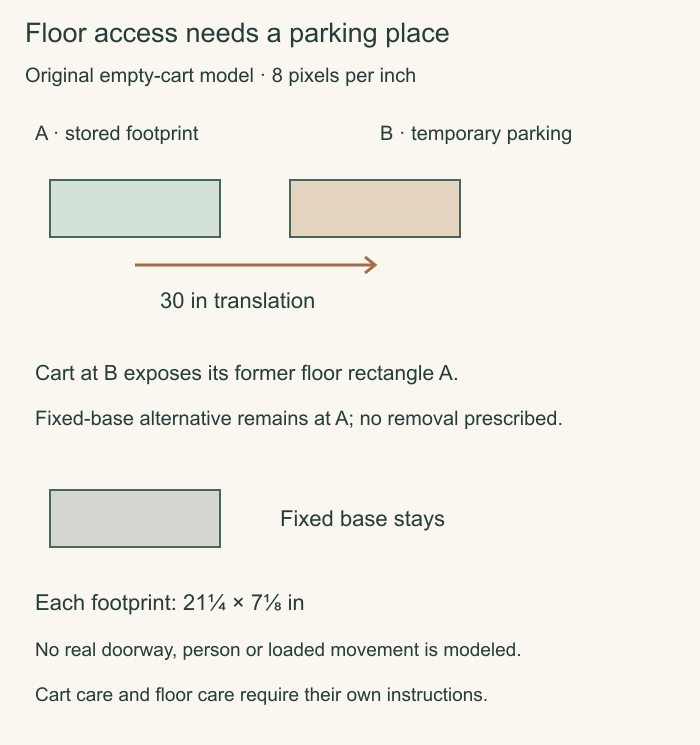
The US VESKEN listing gives a width of 21¼ inches and depth of 7⅛ inches. In our invented plan, that rectangle starts at position A against a wall. Position B is an empty rectangle of the same size, 30 inches farther along the same unobstructed strip. The original drawing shows A, B and the straight translation between them. The numbers establish this model, not a verified route through a real bathroom.
We assume an empty, correctly assembled cart and an actual setting in which an appropriate move can be made. Before applying the idea, resolve the real surface, obstacles, handling needs and instructions. The maker describes four casters and a movable cart; the published maximum load is not a guarantee about moving it when full. Nothing in this comparison requires carrying bottles on a moving shelf or detaching its click-together parts.
Compare what remains on the floor
With the modeled cart at B, its old rectangle A is no longer occupied by the cart. The floor-access task at A can then be considered separately, using the actual floor's cleaning guidance. The parking position matters: putting the cart in the doorway would merely exchange one access problem for another. Our drawing leaves doorways and people outside its limited geometry rather than pretending to certify a bathroom layout.
Now substitute an invented fixed base occupying A. For this comparison, it stays there; the article does not prescribe uninstalling it. The same floor patch is therefore not exposed by the proposed translation. A person may still clean around the base according to the actual materials and installation, but that is a different access condition from removing the footprint entirely. No sanitation result follows from either drawing.
Keep cart care separate from floor care
VESKEN's product page and its linked care sheet instruct wiping the frame with a mild soapy solution, then drying it with a clean cloth. Those are instructions for the identified cart. They are not a floor-cleaning recipe and do not establish compatibility with every bathroom cleaner. The original shelf alternative likewise has no borrowed VESKEN care permission.
The four-page assembly drawing shows the casters, upright connections and finished cart. It supplies no reason to invent a routine of dismantling the structure whenever the floor needs attention. This comparison uses the assembled object and its declared empty condition. If the real cart or location presents a handling problem, that question remains to be resolved before the proposed move becomes a routine.
Choose for the task that actually recurs
For a household that needs to expose this particular patch regularly, I would keep a real parking place beside the stored footprint in the purchase plan. A cart without anywhere appropriate to go may have little practical advantage for that task. A fixed arrangement may suit other priorities, but its appearance alone cannot establish access beneath it.
The comparison ends when the household can identify A, an appropriate B and the actual care requirements. It does not need a new cleaning appliance or a claim that movable furniture is always preferable. The useful difference is whether the planned maintenance task has somewhere for the storage to be while it is happening.
Sources & further reading
Published sources for the details and examples discussed in this story.