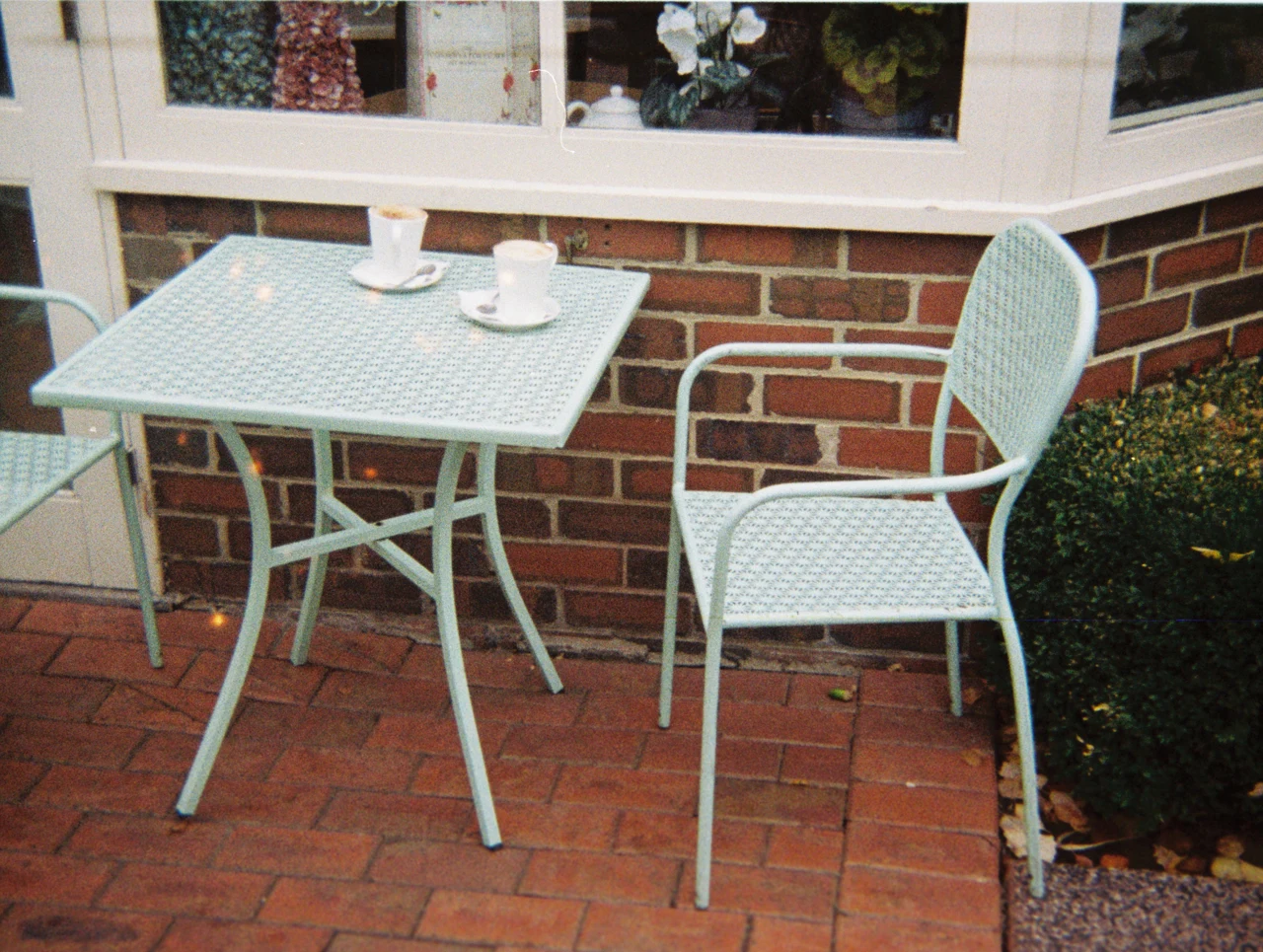
An ordinary break outdoors does not need to become a miniature dinner party. Imagine two people taking a pause at a small table with two suitable cups and a shared jug. They are not hosting a meal or preparing a photographed table setting. The question is what would make this particular arrangement feel considered to them, without requiring a second collection of objects before they can sit down.
The useful objects already make a group
In this original fictional view, the cups belong near the two intended places and the jug occupies a shared part of the table. They are not arranged as an untouchable central display. Their relationship is understandable because each object has a part in the pause. I find that more welcoming than a finished arrangement whose main requirement is to remain undisturbed.
That is a personal interpretation, not a measured social effect or a guarantee that any particular table setup suits every user. No real cups, jug or table have been tested. In an actual setting, use suitable items as directed and consider the real people and conditions rather than copying the hypothetical positions as a layout plan.
One added object changes the purpose of the middle
Now imagine adding a low decorative vessel between the cups. I like its rounded outline in isolation. But on this invented small top it occupies the patch where one person intended to put down their book. Keeping the vessel would mean asking that ordinary part of the break to happen elsewhere.
You could choose that tradeoff if the vessel itself is part of the pleasure. The difference is acknowledging it. The table is no longer arranged only around the two cups, shared jug and the people’s own things; it is also serving a decorative intention. That intention should not be mistaken for a prerequisite of making somebody welcome.
Getty describes space between and around objects as part of a composition. Here the open patch has an actual proposed role in the story, rather than being an empty area that automatically needs filling. Leaving it available can make the arrangement feel complete to the people using it.
Let the break remain smaller than the occasion
Imagine one person saying, “I was only coming out with my book.” That sentence usefully defines the scale of the moment. It does not ask for coordinated napkins, a centerpiece or an outdoor-only set of serving pieces. Adding those things may be enjoyable on another occasion, but they would introduce a different activity here.
The existing cups do not have to match for this particular fictional pair to enjoy them. Nor is mismatch a rule to imitate by buying deliberately different pieces. They are using what already suits the intended pause. If an actual item is unsuitable or unavailable, investigate that specific need rather than treating the whole table as a shopping project.
Buy for the missing use, not the imagined photograph
For this modest break, I would leave the decorative vessel off and keep the patch for the book. Another pair could prefer the object and choose a different arrangement if their actual table allows it. Neither outcome establishes a universal minimum or maximum number of things outdoors.
Before buying, describe what is missing from the ordinary use. A suitable cup may answer a real need; a complete matching display may answer only a photograph in your head. An outdoor table can feel intentionally set because it recognizes what the people are there to do, with room for the pause to become theirs.
Sources & further reading
Published sources for the details and examples discussed in this story.