A curtain drawing can look complete while the fabric is closed and fail when the curtains are opened. The gathered material has to occupy part of the wall beside the glass, which may already belong to a wardrobe door. IKEA's October 2024 VIDGA buying guide asks readers to consider the window opening and furniture placement when measuring. It also recommends adding at least 6 inches on each side for fabric curtains. That is a supplier planning instruction, not a prediction that any curtain pair will compress into 6 inches. A separate drawing of the open state makes the difference visible.
Give the wall a simple coordinate line
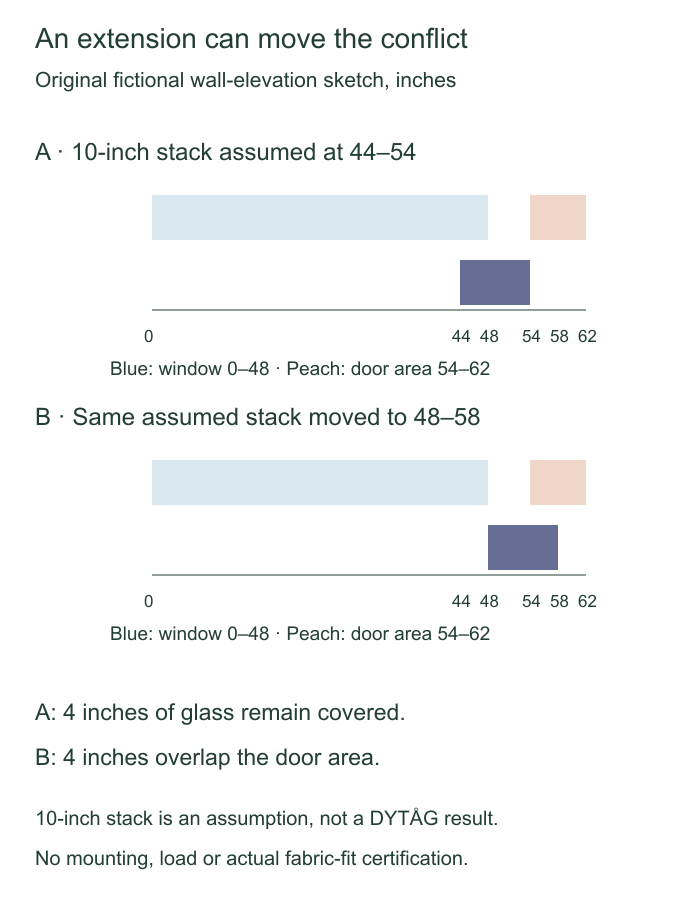
For an original fictional example, let the window run from 0 to 48 inches along a wall. Applying the guide's minimum 6-inch extension on each side gives a first rail-length sketch from−6 to 54:60 inches in total. This is arithmetic for the example, not an order-ready installation drawing. The actual fittings, support and wall conditions still need the appropriate instructions.
Now mark the wardrobe beside the window. In this fictional room, its door and handle need the area from 54 to 62 inches to remain clear when opened. Draw that area as a separate occupied shape rather than reducing it to the cupboard's closed outline. The window and rail have not changed, but the furniture now has a moving state to compare with the curtain's moving state.
Draw a gathered curtain without guessing its compression
Suppose, only for the drawing exercise, that the proposed open right-hand curtain occupies a 10-inch band from 44 to 54. That assumed band leaves 4 inches of the window covered, because the glass ends at 48. Extending the rail another 4 inches and moving the same assumed band to 48–58 would uncover the glass in this sketch, but it would overlap the wardrobe's 54–62 door area by 4 inches.
The useful result is the conflict, not the invented 10-inch stack width. That width has not been measured on a DYTÅG curtain and is not a manufacturer specification. Replace it with a supported measurement or supplier answer for the actual fabric, hanging arrangement and gathered state before ordering. A longer rail can move a problem along the wall rather than remove it.
Keep coverage and gathering as different quantities
The named curtain case is the US DYTÅG white heading-tape pair, article 004.667.15. Its product page identifies two curtains and lists a 57-inch width for one curtain. It also gives a coverage method: multiply rod or track width by 1.5 for a full look, or 2 for an extra-full look, divide by the width of one curtain and round up. Those figures concern fabric coverage and fullness, not a guaranteed open-stack dimension.
For the fictional 60-inch track, the first calculation is 60×1.5=90 inches of fabric;90÷57 is about 1.58, which rounds up to two curtains. The extra-full calculation is 120÷57, about 2.11, which rounds up to three curtains. Since the product is sold as a pair, required curtain count and purchased pair count are different quantities. Neither calculation answers whether the gathered fabric clears the wardrobe.
Choose a layout before committing to a length
The DYTÅG page says heading-tape curtains can hang on a track with gliders and hooks and identifies VIDGA for that arrangement. It also recommends washing before cutting or hemming because the fabric shrinks. Keep the selected hanging method and preparation attached to the drawing rather than borrowing a stack estimate from a photograph of another curtain.
Compare the closed fabric, the open fabric and the open wardrobe on the same sketch. If the intended states conflict, discuss a revised arrangement with the supplier before treating any dimensions as final. The answer may involve where the curtain gathers or which treatment is appropriate, rather than buying more of the same rail. The VIDGA guide is datedOctober 1,2024; use the actual current product documents for the system eventually ordered.
Sources & further reading
Published sources for the details and examples discussed in this story.