
A freezer shelf may be wide enough for a container that cannot pass through its opening. The obstruction could be a drawer front, a fixed edge or another part of the actual appliance. Buying by portion size alone misses that second boundary. Here, two IKEA US containers with lids give the comparison specific dimensions: rectangular 705.779.32 and round 305.779.34. The opening and shelf below are invented. This is a dimensional planning exercise, not a food-storage temperature, filling or freezing procedure.
Keep the complete product identity beside its measurements
The rectangular 34-ounce item is listed at 8¼ inches long, 6 inches wide and 2¼ inches high. The round 25-ounce item is listed at 5½ inches in diameter and 3½ inches high. Both identified listings describe containers with lids and state freezer suitability. Their volumes differ; this is not an equal-capacity test or a claim that one holds a particular household's portion.
Use the product measurements rather than the retail package dimensions. The listed package can contain several nested pieces, so its height does not describe one closed container. Before ordering for a tight space, ask the supplier to confirm the widest actual closed outline, including projecting lid features. Nominal listing numbers are a useful first comparison, not proof that every edge will pass a real opening.
A larger interior does not enlarge the entrance
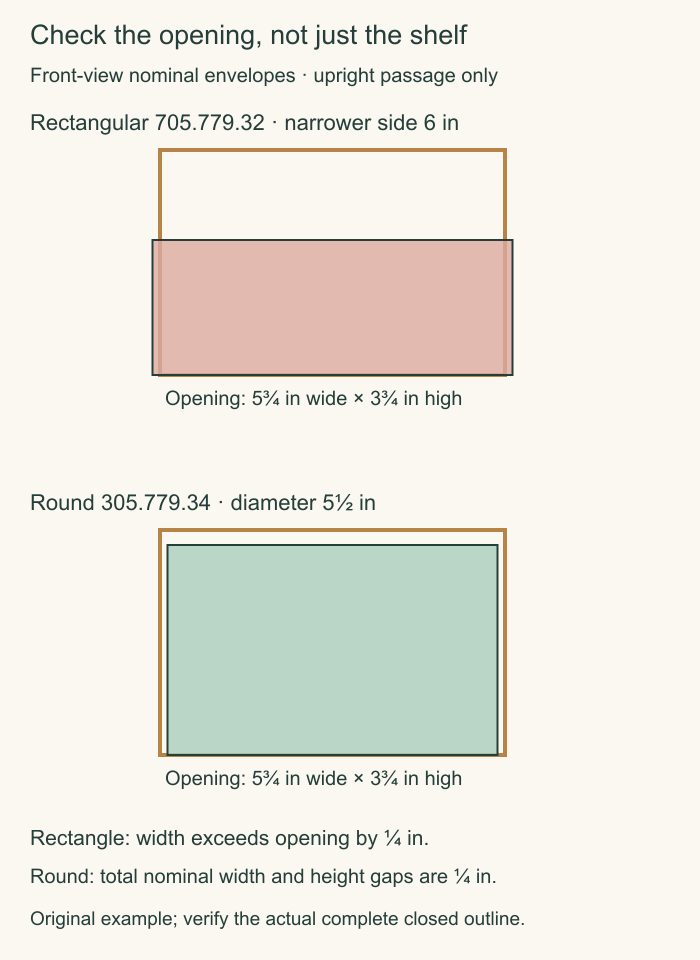
Imagine a shelf space 12 inches wide and 10 inches deep, reached through an opening only 5¾ inches wide and 3¾ inches high. The example assumes a straight, upright passage with no tilting and no other obstruction. Both listed footprints could occupy part of the larger interior in an axis-aligned plan. That observation does not answer whether they can get there.
The rectangular container's narrower listed side is 6 inches. That already exceeds the opening width by ¼ inch. Turning its 8¼-inch side toward the opening makes the width larger, not smaller. Under the stated upright model, a diagonal rotation of this rectangle does not create a width below its narrower side. Do not solve the failed comparison by assuming the lid will bend through.
The round outline gives a different provisional result
The round item's listed 5½-inch diameter is ¼ inch below the hypothetical 5¾-inch opening. Its 3½-inch height is also ¼ inch below the hypothetical height. Those differences are total nominal gaps, not an extra ¼ inch on each side. They leave little room for a real measurement discrepancy or a feature not captured by the simplified outline.
This round outline therefore passes the first geometric screen while the rectangle fails it. That is a narrower conclusion than ‘buy the round one.’ The actual opening may have another restriction, the container may not suit the needed quantity, or the lid may need more space to be handled comfortably. A favorable subtraction does not establish that the setup is usable.
Draw the removal as well as the arrival
On the sketch, leave the entrance clear and show the closed container moving straight into the shelf. Now imagine another item placed immediately in front of it. The interior still has the same dimensions, but retrieving the container would require moving that item first. Decide whether that extra step belongs in the household routine before filling every available position.
Measure the real appliance's usable opening and interior separately, following its instructions and keeping its required clearances. Compare the actual container in the state in which it will be stored. No shelf measurement overrides the appliance's loading limits or the food's own handling requirements. This article supplies neither a maximum safe stack nor a suggested storage duration.
Compare the order that would actually be useful
The cited listings are multipacks, so check included quantity rather than comparing one headline price as though it bought one of each shape. Keep the exact US article numbers with any enquiry; a similarly named glass item or a different lid is another product. No current stock or price promise is needed to identify the dimensional conflict.
If an existing container already handles the portion and passes the actual opening, another matching set may add little. The useful shopping result is a small requirement: a complete closed outline that can enter, sit in the intended place and be retrieved. Capacity belongs alongside those conditions, rather than standing in for all three.
Sources & further reading
Published sources for the details and examples discussed in this story.